

Who We Are
Center for Interdisciplinary Biosciences
Center for Interdisciplinary Biosciences (CIB) is a co-founder of Technological and Innovative Park at P.J. Safarik University (TIP) ( http://www.upjs.sk/pracoviska/tip/ ).
We focus on advanced interdisciplinary research at the interface of biophysics, molecular biology, biochemistry, bioinformatics, and biomedicine. By applying integrative approaches, we investigate complex biological systems at the molecular level and translate this knowledge into applications in medicine and biotechnology.
Our mission is to transform fundamental research into practical, high-value solutions for the biotechnology and pharmaceutical sectors.
Research Areas and Commercial Applications
From Gene to Protein - All in One Place
Our center provides a complete research and development pipeline, covering every stage from the initial design and construction of genetic libraries to the production, purification, and biophysical characterization of protein variants. Each phase is carried out by specialized laboratories that are closely interconnected, ensuring systematic coordination and seamless workflow integration.
This integrated approach significantly reduces the time between concept development and experimental outcomes while eliminating the need for multiple external providers across different stages of the project.
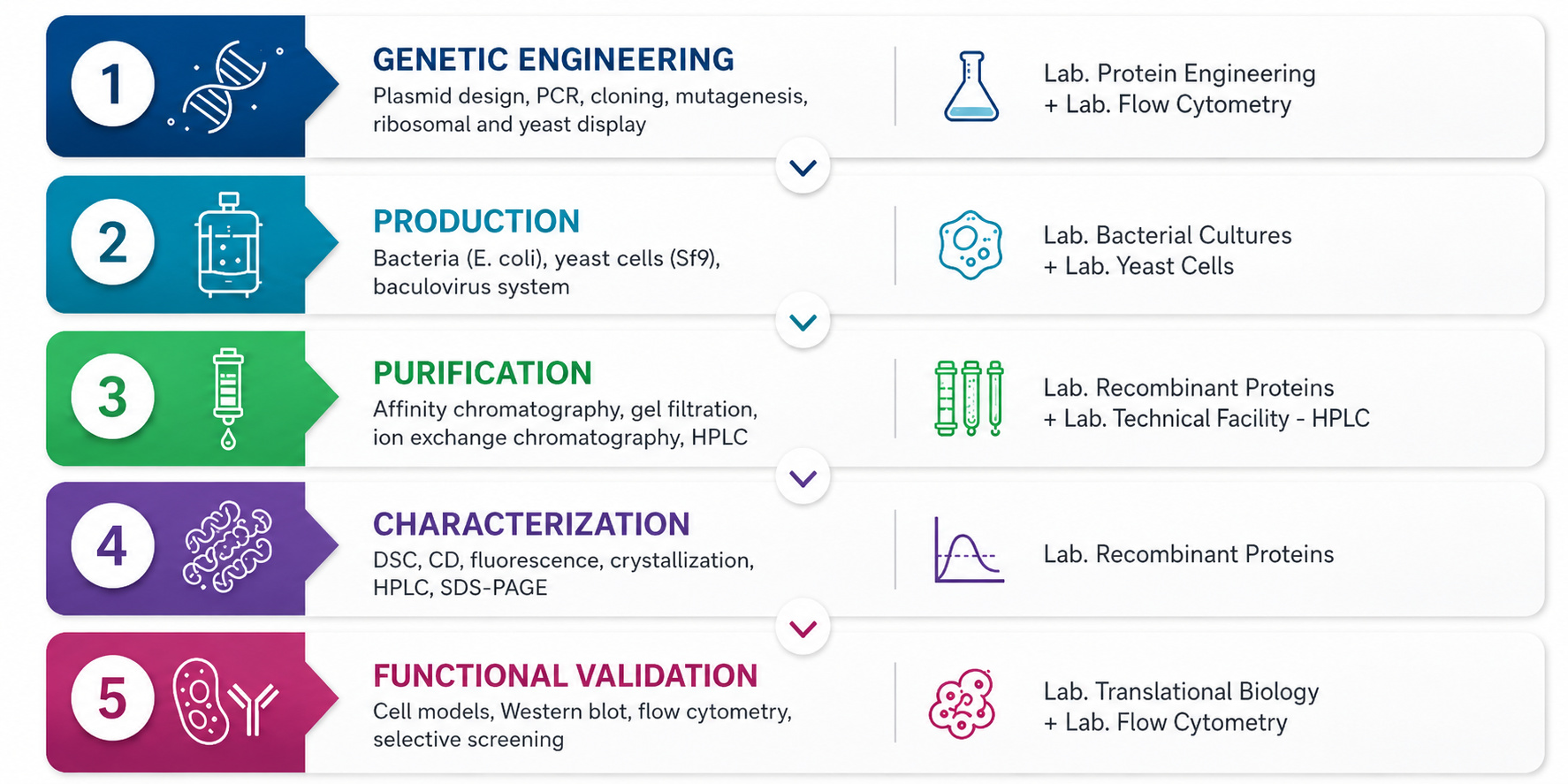
What Do the Individual Steps Mean in Practice?
1. Genetic Engineering - Designing and Creating Diversity
Every successful molecule begins with a well-designed strategy. Using advanced bioinformatics tools, we analyze sequence, structural, and functional data to identify promising targets for rational modifications and to support the design of variants with desired properties. We generate extensive libraries of gene variants using both rational design approaches - when the target region is known - and directed evolution strategies, where natural selection principles are accelerated under controlled laboratory conditions. Our methodologies include error-prone PCR, molecular cloning, ribosome display, and yeast display technologies. The result is a diverse collection of thousands to millions of variants ready for downstream screening and functional evaluation.
2. Protein Production - Manufacturing Proteins in Living Cells
Once promising variants have been identified, the next step is their efficient production at larger scale. Proteins are not synthesized chemically; instead, they are produced by living cells programmed with the corresponding genetic information. Depending on the complexity of the target protein, we select the most suitable expression system. Bacterial systems provide rapid and cost-effective production for simpler proteins, while insect cell systems are used for more complex eukaryotic proteins requiring proper post-translational modifications, disulfide bond formation, or glycosylation.
3. Purification - Isolating the Target Molecule
Following expression, the target protein must be selectively isolated from a highly complex cellular environment while maintaining the purity and stability required for downstream applications. Our purification workflows employ advanced chromatographic techniques, including affinity chromatography, size-exclusion chromatography, ion-exchange chromatography, and HPLC analysis. Protein purity is routinely verified using SDS-PAGE, followed by quantitative assessment of production yield.
4. Characterization - Understanding Molecular Properties
Obtaining a purified protein is only the beginning - understanding its behavior and biophysical properties is essential. We investigate thermal stability, secondary structure, conformational dynamics, and molecular interactions using differential scanning calorimetry (DSC), circular dichroism (CD), fluorescence-based methods, mass photometry, and FIDA technologies. In addition, protein crystallization enables structural analysis at atomic resolution, providing detailed insights into molecular architecture and function.
5. Functional Validation – Confirming Biological Activity
The final stage verifies whether selected variants perform as intended in a biological context — not only binding to their targets, but also producing the desired biological effect. For functional validation, we utilize cell-based assays, Western blot analysis, surface plasmon resonance (SPR), FIDA technologies, and flow cytometry methods. In iterative optimization workflows, the best-performing variants can be reintroduced into the engineering pipeline for additional rounds of directed evolution and refinement.
The Center for Interdisciplinary Biosciences is open to collaboration with research teams and institutions across both academic and industrial sectors.
Currently, CIB collaborates with the following academic institutions:
- University of Zurich, Switzerland (group of Prof. A. Plückthun),
- EPFL Lausanne, Switzerland (Prof. H. Van der Berg, Dr. Georges Wagnieres),
- IEM CSIC Madrid, Spain (Dr. S. Sánchez-Cortés),
- Paris 6 University, France (Dr. F. Sureau).
- SAFTRA photonics s.r.o..